SFPs / Transceivers
Lantronix TN-SFP-SXB Series Gigabit BiDi Multimode SFP Transceivers
The TN-SFP-SXB Series is a matched pair of Gigabit SFP transceivers that run 1000Base-SX over a single multimode fiber, using opposite 1310 nm and 1550 nm wavelengths so one strand carries both directions.
From $302.50
Overview
About the Lantronix TN-SFP-SXB Series
Most multimode Gigabit SFPs need a fiber pair. The TN-SFP-SXB (also written TN SFP SXB) halves that: each module transmits on one wavelength and receives on the other over a single LC multimode strand, so a building with limited spare fiber can add Gigabit links without new cable. The two part numbers are mirror images and are always deployed as a pair, one at each end.
TN-SFP-SXB1 transmits at 1310 nm and receives at 1550 nm; TN-SFP-SXB2 transmits at 1550 nm and receives at 1310 nm. Both reach 500 m (1640 ft) on multimode fiber with a 7.0 dB link budget. The modules are hot-pluggable, comply with the SFP Multi-Source Agreement and IEEE 802.3, and include digital diagnostics (DMI) for monitoring optical levels from the host.
Each module draws 0.66 W from 3.3 V and operates from 0°C to 70°C, with IEC 60825 and FDA 21 CFR 1040.10 and 1040.11 laser safety compliance. Lantronix lists Gigabit Ethernet switches and routers, Fibre Channel switch infrastructure, xDSL and metro edge switching as applications.
Key capabilities
- One fiber, both directions
- Bidirectional 1310/1550 nm optics carry Gigabit Ethernet in both directions over a single multimode strand, doubling the links on existing fiber.
- 500 m multimode reach
- Both modules reach 500 m (1640 ft) with a 7.0 dB link budget, enough for most in-building and short campus runs.
- Digital diagnostics built in
- DMI reports transceiver optical and electrical parameters to the host switch for link monitoring and troubleshooting.
- MSA hot-pluggable
- Standard SFP Multi-Source Agreement footprint with hot-plug support fits Gigabit SFP ports on switches, routers and media converters.
- 0.66 W per module
- Low power draw from a 3.3 V supply keeps heat down in densely populated SFP cages.
How to choose the right TN-SFP-SXB Series part number
Order one of each. TN-SFP-SXB1 transmits at 1310 nm and receives at 1550 nm; TN-SFP-SXB2 transmits at 1550 nm and receives at 1310 nm. A link only works when an SXB1 at one end faces an SXB2 at the other, over a single multimode fiber with LC connectors. Specifications are otherwise identical: 1000Base-SX, 500 m, 7.0 dB budget and DMI. TN-SFP-SXB1 is also listed as TAA compliant.
Configure & order
Find your TN-SFP-SXB Series part number
Every orderable TN-SFP-SXB Series configuration, filtered by the specs that actually differ between them. Pick what you need on the left and the matching part numbers appear here.
TN-SFP-SXB1
$302.50
Ships on backorder
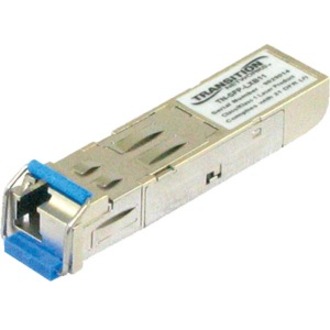
TN-SFP-SXB2
$302.50
Ships on backorder
Where the TN-SFP-SXB Series is used
- Gigabit links over a single spare multimode fiber strand
- Adding switch uplinks in buildings with exhausted fiber pairs
- Metro edge switching and router interconnects
- Fibre Channel switch infrastructure over multimode
TN-SFP-SXB Series datasheets & documentation
TN-SFP-SXB Series FAQ
Do TN-SFP-SXB1 and TN-SFP-SXB2 need to be used together?
Yes. They are complementary bidirectional modules. SXB1 transmits at 1310 nm and receives at 1550 nm, and SXB2 does the reverse, so each single-fiber link needs one SXB1 and one SXB2.
How far does the TN-SFP-SXB reach on multimode fiber?
Both modules reach 500 m (1640 ft) over multimode fiber with a 7.0 dB link budget. They use a single LC fiber per link rather than a duplex pair.
Do TN-SFP-SXB modules support DDM/DMI?
Yes. Both part numbers include digital diagnostic monitoring (DMI), so a compatible host switch, router or media converter can read the transceiver's optical and electrical values for link monitoring.
What is the power consumption and temperature range of the TN-SFP-SXB?
Each module consumes 0.66 W from a 3.3 V supply and operates from 0°C to 70°C. The modules comply with IEC 60825 and FDA 21 CFR 1040.10 and 1040.11 laser safety requirements.