Serial-to-Ethernet Modules
Lantronix XPort Embedded Serial-to-Ethernet Device Server Modules
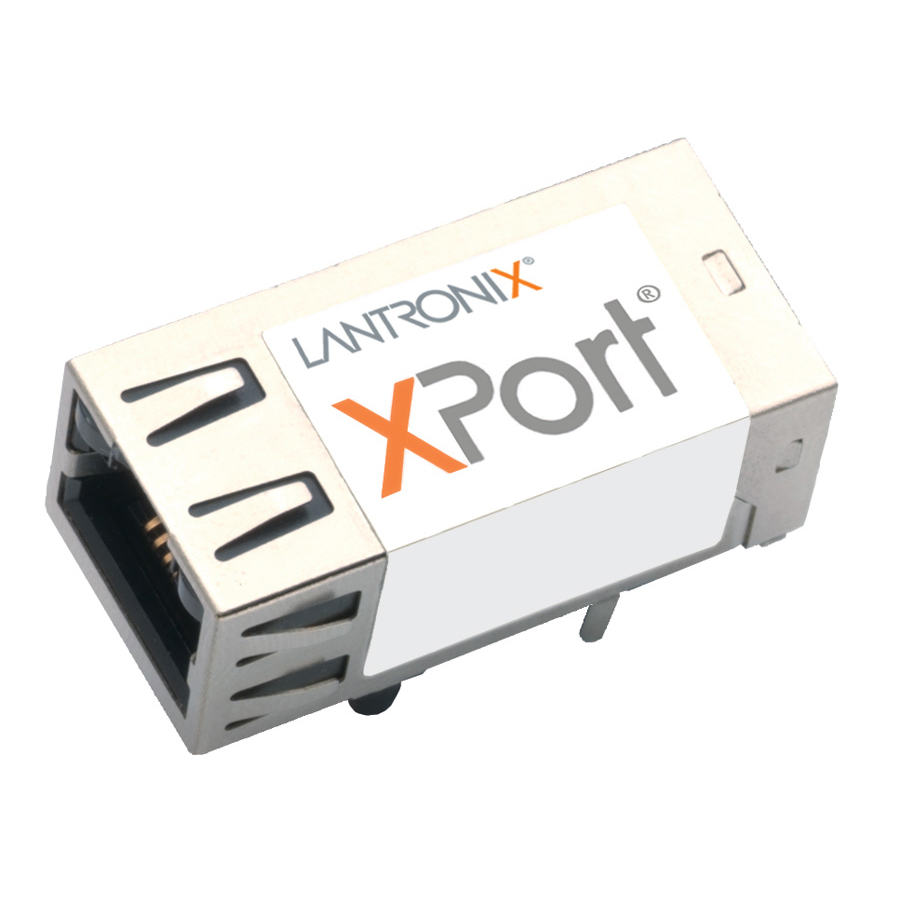
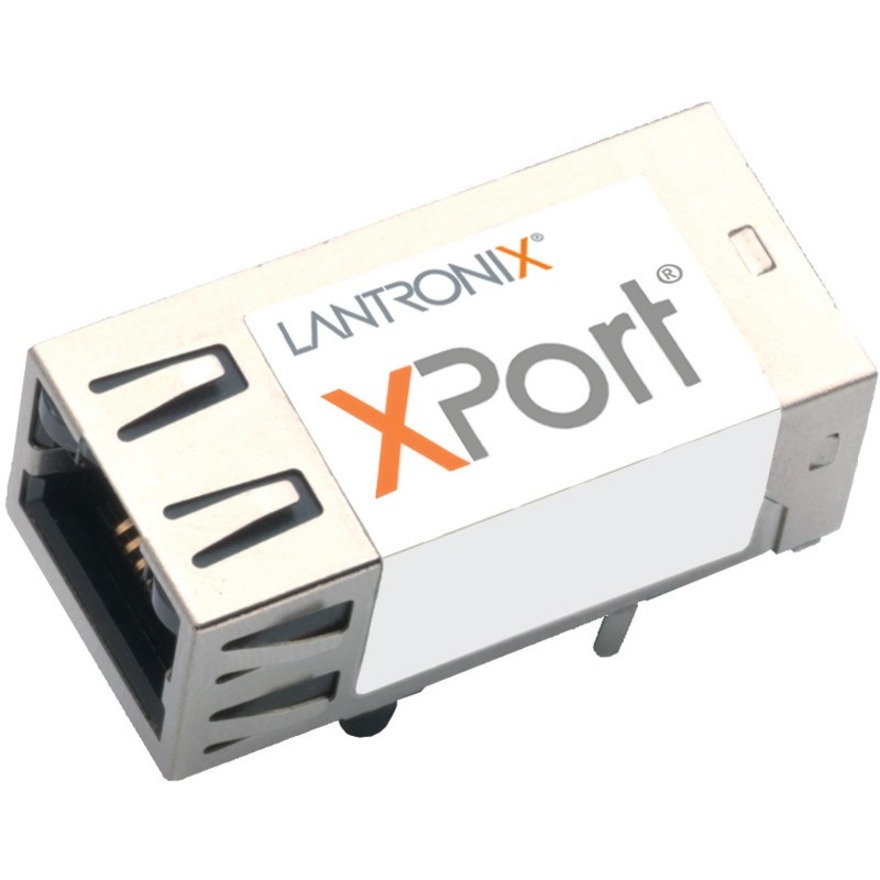
The XPort is an embedded Ethernet device server packaged inside an RJ45 connector, letting product designers add 10/100 Ethernet, a web server and a full TCP/IP stack to any device with a serial port.
From $51.70
Overview
About the Lantronix XPort
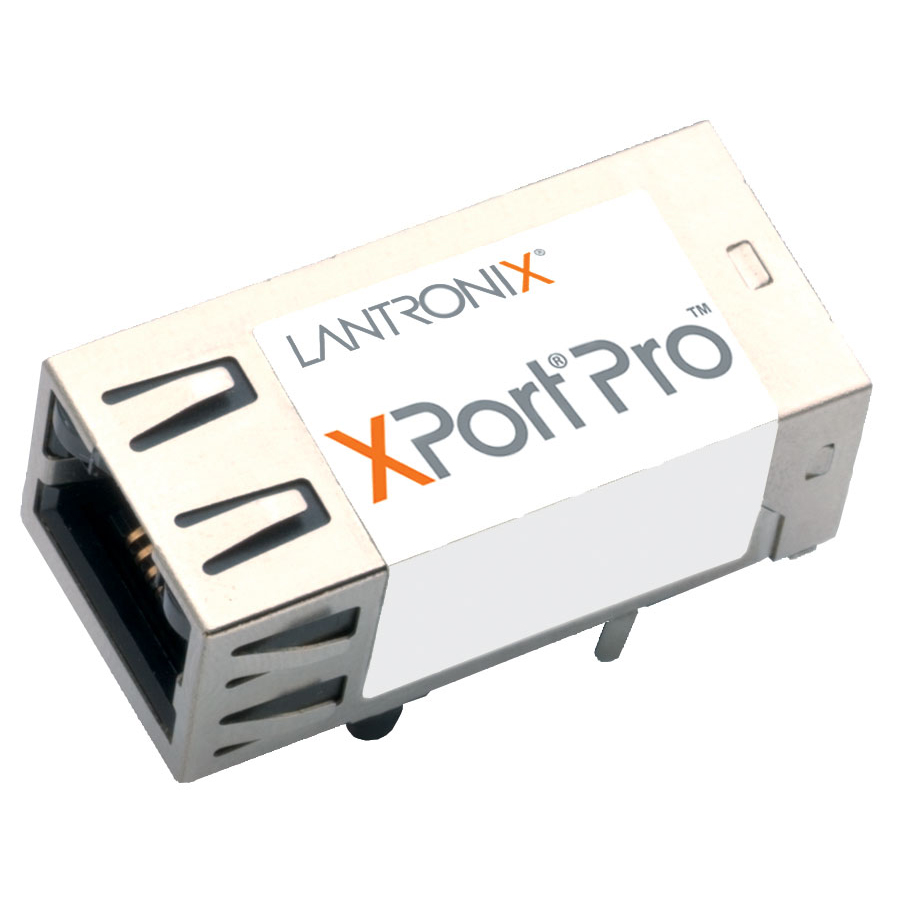
The XPort (also written Xport, with production part numbers starting XP100) puts a complete serial-to-Ethernet device server into the space of an RJ45 jack. The device manufacturer solders it onto the board in place of a standard network connector, connects it to the host processor's UART, and gets network access and control without developing or licensing a networking stack. The module acts as a dedicated network co-processor, so the host microprocessor keeps its cycles for the application.
Inside is a DSTni-EX 16-bit x86-architecture processor at 48 or 88 MHz with 256 KB SRAM and 512 KB flash, running a real-time operating system, TCP/IP, UDP, SNMP, DHCP, BOOTP, Telnet, TFTP, HTTP and AutoIP. The CMOS serial interface is 5 V tolerant and runs from 300 bps to 921,600 bps with RTS/CTS and XON/XOFF flow control, plus three programmable I/O pins. The built-in web server stores 384 KB of custom pages for configuration and monitoring.
The XPort runs from 3.3 VDC, operates from -40 °C to 85 °C and measures 33.9 x 16.25 x 13.5 mm. The SE versions add 256-bit AES encryption. Configuration uses the Windows DeviceInstaller utility, the web manager, Telnet or serial, and Com Port Redirector lets PC software reach the device as a virtual COM port.
Key capabilities
- Device server in RJ45
- The module replaces the board's RJ45 jack and contains the Ethernet MAC/PHY, processor, memory and network software in a 9.6 g package.
- Optional AES encryption
- XPort SE models add 256-bit AES Rijndael encryption for secure communications between the device and the network.
- Custom web pages
- 384 KB of web page storage lets manufacturers build browser-based configuration, monitoring and troubleshooting screens for their product.
- Industrial temperature range
- Operates from -40 °C to 85 °C, so the same module fits industrial controllers, access control panels and outdoor equipment.
- Modbus option
- XP1001000M-05R adds Modbus support to the XE module, with protocol setup documented in the Lantronix APS Modbus Protocol User Guide.
How to choose the right XPort part number
XPort XE parts omit encryption: XP1001000-05R is the standard module and XP1001000M-05R adds Modbus. The XPort SE part XP1002000-05R adds 256-bit AES encryption. All three are RoHS, extended-temperature modules listed with a 50-unit minimum order quantity. XP100200S-05R is the encrypted SE module offered as a sample for prototyping. The XP10010NMK-01 Universal Demo Board is the evaluation kit; modules are ordered separately.
Configure & order
Find your XPort part number
Every orderable XPort configuration, filtered by the specs that actually differ between them. Pick what you need on the left and the matching part numbers appear here.
XP1001000-05R
$51.70
Ships on backorder
XP1001000M-05R
$52.99
Ships on backorder
XP1002000-05R
$53.52
Ships on backorder
XP100200S-05R
$56.52
Ships on backorder
Complete the deployment
Accessories, renewals & add-ons
Everything sold for the XPort, organized by what it does — evaluation & development kits— each with why you'd add it.
Evaluation & development kits
1 item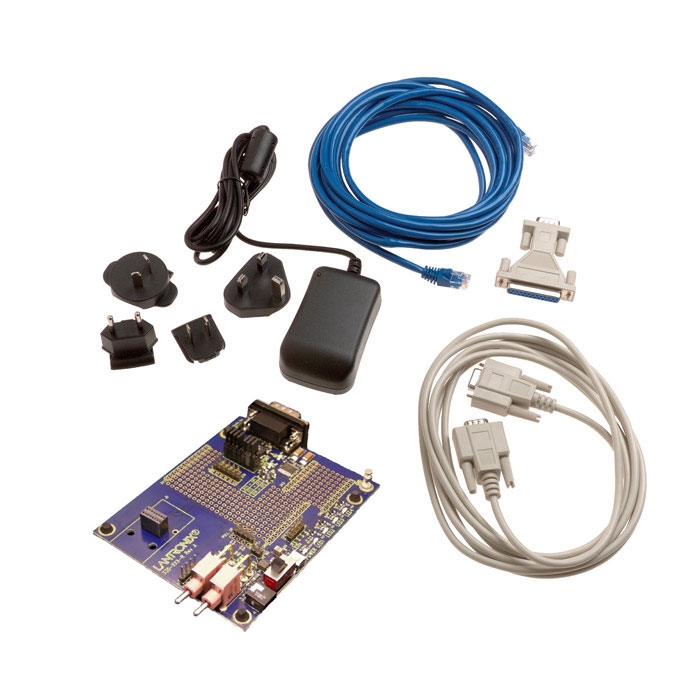
XPort Demo Board
XP10010NMK-01
The XPort / XPort Pro Evaluation Kit is designed with all the necessary items to help you successfully implement the XPort / XPort Pro / XPort Pro Lx6 into your product design.
Compatibility taken from the Lantronix part-number tables for the XPort. Don't see what you need? Request a quote — we can source the full Lantronix catalog.
Where the XPort is used
- Adding Ethernet and a web interface to serial equipment designs
- Networking motion controllers and intelligent motors
- Remote monitoring and maintenance of commercial printers
- Access control and security panels on IP networks
- Traffic controllers communicating over IP backbones
XPort FAQ
What is the difference between XPort XE and XPort SE?
XPort SE (XP1002000-05R) includes optional 256-bit AES encryption for secure communications. XPort XE (XP1001000-05R) does not include encryption, and XP1001000M-05R is the XE version with Modbus. All are RoHS extended-temperature modules.
What serial interface does the XPort use?
It uses a 5 V tolerant asynchronous CMOS serial interface at 300 bps to 921,600 bps, with 7 or 8 data bits, odd, even or no parity, 1 or 2 stop bits, DTR/DCD and CTS/RTS control signals, and three programmable I/O pins.
What voltage and temperature range does the XPort support?
The XPort runs from a single 3.3 VDC supply and operates from -40 °C to 85 °C (-40 °F to 185 °F), with the same storage range. All listed part numbers are extended-temperature, RoHS-compliant versions.
Is there an evaluation board for the XPort?
Yes. The XP10010NMK-01 XPort Universal Demo Board is the evaluation kit, with its own quick start guide and user guide. XPort modules must be ordered separately; XP100200S-05R is available as a sample SE module.
How is the XPort configured?
Use the Windows-based DeviceInstaller utility to find modules on the subnet, assign IP addresses, and load firmware and custom web pages. Configuration is also available through the internal web server, Telnet, SNMP or the serial port, and firmware can be upgraded via TFTP or serially.